MWC 2026: The Invisible Revolution Behind the Screens (by Jordi Kohn I|A INTANGIBLE ASSETS Founder)
From March 3rd to 5th, Barcelona once again becomes the epicenter of the tech universe. Walking through the halls of Fira Gran Via during the Mobile World Congress (MWC) is, for many, a sensory overload of foldable screens, humanoid robots, and next-gen antennas. However, the most valuable assets being traded in these corridors cannot be touched or packed into a suitcase: they are intangible assets.
In 2026, the industry has finally understood that hardware is just the "packaging." The true engine of the digital economy is invisible.
The Value of the Unseen
Traditionally, a company's success was measured by its factories, trucks, or inventory. Today, in the midst of the Artificial Intelligence explosion and 6G connectivity, the board has flipped.
According to recent reports, the vast majority of corporate value in the S&P 500 resides in intangibles. But what exactly are we talking about when we say "intangibles" at MWC?
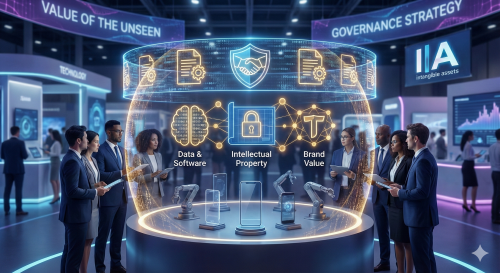
- Intellectual Property (Patents): The algorithms that allow your phone to recognize your face or ensure 5G doesn't drop in a crowded stadium.
- Data and Software: The "new gold." The ability to process real-time information to predict traffic or manage a smart city.
- Brand and Reputation: The trust that makes you choose one manufacturer over another—an asset that takes decades to build and seconds to destroy.
The "Digital Moat": Why Protection is Vital
Innovation without protection is essentially a gift to your competitors. In the knowledge economy, intangible assets act as the "moat" of a medieval castle.
While the headlines focus on the latest smartphone model, the backrooms of MWC are a battlefield for protected ideas.
- Standard Essential Patents (SEPs): These are the critical technologies required to comply with industry standards (like 5G). If you own them, the industry pays you royalties.
- Trade Secrets: With the rise of AI, many companies are choosing not to patent their algorithms (which would require public disclosure) and instead protect them as secrets, much like the Coca-Cola formula.
- Copyright: The shield for the code that powers the platforms.
Governance: Bringing Order to Chaos
It is no longer enough to simply file a patent and hang the certificate on the wall. That is bureaucracy, not strategy. Governance of Intangibles implies managing these assets with the same rigor used for treasury or physical inventory.
Effective governance in 2026 involves:
- Identification: Many tech companies possess assets they don't even know exist (e.g., a database structured by a marketing team or an optimization script written by an engineer).
- Valuation: What is your AI algorithm actually worth? Putting a price tag on the invisible is crucial for raising capital or M&A activity.
- The AI Challenge: As Generative AI becomes ubiquitous, governance is key to answering: Who owns the output? and Are we infringing on third-party rights by training our models on this data?
Conclusion: From Invention to Profitability
The message for MWC attendees is clear: technology is ephemeral; well-managed intellectual property is durable.
Success in Barcelona will not be measured solely by who has the largest booth or the flashiest demo, but by who has built the strongest governance structure capable of turning brilliant ideas into defensible, scalable, and monetizable financial assets.
"In today's economy, what you own physically allows you to operate, but what you own intellectually allows you to lead."