I|A INTANGIBLE ASSETS x MWC Barcelona 2026: turning “The IQ Era” into governed, defensible value (by Jordi Gonzalez I|A INTANGIBLE ASSETS Founder)
MWC Barcelona 2026 is framed around “The IQ Era,” with six themes that capture where the market is heading: Intelligent Infrastructure, ConnectAI, AI 4 Enterprise, AI Nexus, Tech4All, and Game Changers.
If you read that list as a technology roadmap, you’re right.
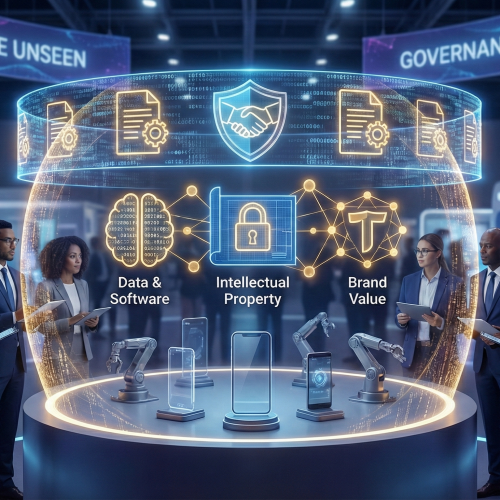
But if you read it as a value roadmap, you’re even more right-because what these themes really describe is the acceleration of intangible assets as the primary source of enterprise value (and enterprise risk): data, software, AI models, brands, customer relationships, ecosystem contracts, proprietary processes, and talent.
That’s the synergy with I|A INTANGIBLE ASSETS: helping organizations make these assets visible, governable, defensible, and monetizable-and translating them into board-level language that drives decisions in strategy, risk, reporting, and transactions.
MWC is where the future gets demoed. I|A is about making sure the future is also owned, controlled, and valuable.
Below is a practical map of how I|A aligns with MWC Barcelona 2026-theme by theme-and why it matters for leaders who want to scale AI and connectivity without scaling chaos.
1) Intelligent Infrastructure: when networks become platforms, contracts become strategy
“Intelligent Infrastructure” is the story of networks evolving into programmable platforms-powered by cloud, edge, automation and AI. In this shift, the biggest value isn’t only in bandwidth; it’s in the intangible layer:
- orchestration software and automation logic
- data generated by the network and services
- models embedded in operations and products
- APIs and platform capabilities sold to partners
- service reliability, resilience, and trust
Where deals fail (and margins leak): ownership and rights.
Who owns the data? Who owns derivatives? What happens when vendors change? What obligations exist if the platform fails?
I|A lens: build an “asset reality” behind the platform:
- clear asset inventory (data, software, models, know-how)
- chain-of-title and licensing clarity
- third-party dependency governance (cloud + vendors + integrators)
- resilience framed as measurable value-at-risk (not just “IT risk”)
When infrastructure becomes intelligent, governance becomes commercial.
2) ConnectAI: connectivity is the substrate; data + models + trust is the product
ConnectAI is the business reality of 2026: connectivity enables new services, but differentiation comes from how data and AI are used, and whether customers trust that use.
This is where many organizations hit the same friction:
- “We want to monetize our data.”
- “We’re building AI-powered services.”
- “We’re exposing network APIs.”
…and then procurement, compliance, and customers ask: What exactly are we buying? What are the risks? Who owns the outputs?
I|A lens: treat “trust” as a managed intangible asset.
- define data rights and permitted uses (including derived data)
- clarify ownership of outputs (models, insights, embeddings, fine-tunes)
- contract the risk (liability, security, audit, governance commitments)
- build a defensible story: not just “we’re compliant,” but “we’re governable”
ConnectAI is where AI monetization meets legal reality. Intangible strategy prevents revenue ambition from turning into regulatory or reputational exposure.
3) AI 4 Enterprise: scaling AI means scaling intangible governance
AI 4 Enterprise is where pilots end and scaling begins-and where hidden gaps start to cost real money.
At scale, AI isn’t a feature. It’s an operating model:
- model lifecycle management
- data governance and provenance
- security controls and access
- documentation, auditability, accountability
- business continuity and vendor management
Most organizations have “AI initiatives.” Fewer have a managed portfolio of AI assets.
I|A lens: “assetize” AI so it becomes governable:
- create an inventory of AI assets (datasets, models, prompts/agents, pipelines, tools)
- document provenance and rights (training data, third-party components)
- define accountability and decision controls (who can deploy what, where, and why)
- translate AI risks into business language (revenue impact, legal exposure, brand risk)
Enterprise AI will increasingly be judged not by demos-but by governance maturity. The organizations that can evidence ownership and control will win bigger customers, better terms, and faster approvals.
4) AI Nexus: ecosystems create value fast-and ambiguity faster
AI Nexus is the partnership theme: platforms, startups, enterprises, public sector, academia. MWC is one of the world’s best “collision spaces” for these ecosystems.
But ecosystems are where intangible assets get messy:
- co-development that blurs ownership
- data sharing with unclear rights
- models fine-tuned across partners
- contracts that quietly transfer value to someone else
I|A lens: make partnership value non-leaky:
- co-development “hygiene” (who owns improvements, derivatives, and outcomes)
- licensing structures aligned to your value thesis (not just vendor templates)
- transaction readiness (because many partnerships become acquisitions-or disputes)
If you want ecosystems to compound value, you need the legal and governance scaffolding that keeps value where it belongs.
5) Tech4All: inclusion, responsibility, and sustainability are now “license to operate”
Tech4All brings a crucial layer: inclusion, accessibility, responsible deployment, and trust. These are not “nice-to-have” narratives anymore; they increasingly shape:
- procurement decisions
- regulator expectations
- talent attraction/retention
- investor scrutiny
- brand strength and customer loyalty
I|A lens: treat reputation and “license to operate” as strategic assets.
- align public commitments with measurable evidence (policies, controls, outcomes)
- manage brand and stakeholder trust as risk-and-value drivers
- link human capital, culture, and training to operational resilience
- support sustainability and reporting expectations with traceable governance
In 2026, trust is not a marketing line. It’s a balance-sheet-adjacent asset.
6) Game Changers: frontier tech means frontier intangible portfolios
Game Changers is where emerging domains accelerate: space, smart mobility, next-gen compute, new interfaces, new identity and security models. Frontier tech amplifies the importance of intangible assets because competitive advantage is mostly:
- IP strategy (what to patent vs keep as trade secret)
- proprietary know-how and processes
- regulatory navigation
- platform and ecosystem positioning
I|A lens: build a repeatable strategy for protecting and monetizing innovation:
- IP + trade secret governance tied to product roadmaps
- regulatory know-how treated as a transferable capability
- value narrative ready for fundraising, partnerships, or M&A
In frontier domains, the winner is often the firm that can prove and protect differentiation-not just claim it.
The five MWC conversations I|A can anchor (and convert into action)
Across the agenda, these questions appear again and again-sometimes explicitly, sometimes between the lines:
- “We want to monetize data/AI/network APIs-what do we actually own?”
- “Our AI is scaling-are we assurance-ready for customers, auditors, regulators?”
- “We rely on hyperscalers and key vendors-what is our lock-in risk and exit reality?”
- “We’re partnering fast-are our intangibles protected or silently leaking?”
- “We talk trust and responsibility-can we evidence it and protect the brand asset?”
This is the overlap between MWC’s “what’s next” and I|A’s “what’s real.”
Why this matters in 2026: the IQ Era is an intangible asset era
MWC Barcelona 2026 is more than a tech conference; it’s a marketplace of intangible value. The strategic edge won’t come only from having AI. It will come from having AI that is:
- owned (rights are clear)
- controlled (governance is operational)
- defensible (risk is managed, trust is evidence-based)
- monetizable (value can be contracted and priced)
- transaction-ready (transferable, auditable, investable)
That’s the synergy: MWC shows what can be built. I|A ensures it becomes sustainable value.
If you’re attending MWC 2026 and any of these themes match your priorities, I’d love to compare notes-especially if you’re exploring data/AI monetization, platform partnerships, or transaction readiness in the IQ Era.